

There are times in life when words are no longer enough. When the mind spins in circles, stuck in the known, even if that known hurts. We create barriers. We close doors. The field of possibilities narrows.
When sound becomes a key
Sound—when produced with precision and presence—is not simply a wave. It is a key. A vibration capable of unlocking forgotten, or even unsuspected, spaces. Spaces of calm, healing, and sometimes even transformation.
What is sound therapy?
Sound therapy is an unconventional wellness approach that uses the power of sounds and vibrations to promote a state of deep relaxation, restore inner balance, and provide a space conducive to transformation and personal exploration.
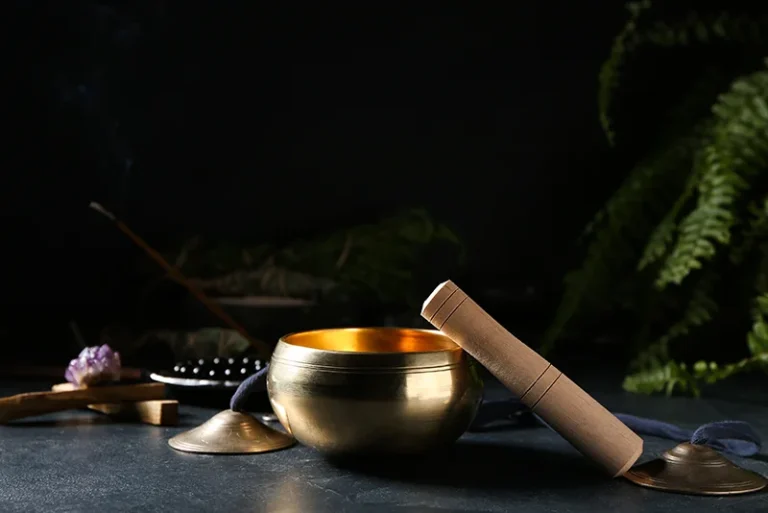
This method uses various instruments: Tibetan bowls, gongs, therapeutic tuning forks, shamanic drums, or even the voice, to produce vibrations that resonate in the body and mind.
Each cell, each organ, vibrates at its own frequency. When stress, fatigue, or emotional overload accumulate, this balance can be disrupted. Blockages form and build up.
The role of sound therapy is to restore vibration, to loosen these knots, to realign. It’s not so much a technique as an invitation to listen, to listen to oneself differently. To allow oneself to be moved by it. And sometimes, to rediscover oneself. To become who one truly is.

Séance de Sonothérapie
Sound therapy and energy rebalancing: when sound resonates with our subtle energy centers
For millennia, various traditions—particularly in India, Tibet, and China—have described the human body as being traversed by flows of energy. These subtle currents are said to be regulated by major energy centers, called chakras in the Hindu and yogic traditions.
Today, even though Western science has not validated the anatomical existence of chakras, a bridge is beginning to be built between neurobiology, vibrational physics, bioenergy, and traditional practices. Sound therapy is part of this bridge, offering a gentle vibrational action on the mind-body system, which can support the harmonization of these subtle centers.
Séance de Sonothérapie
What science says
Recent research has begun to explore the measurable benefits of sound therapy and related sound practices:
Neurological effects: modulation of brain waves
The human brain produces different types of electrical waves depending on the state of consciousness:
Wave type | Frequency | Associated state |
|---|---|---|
Bêta | 13–30 Hz | vigilance, analytical thinking |
Alpha | 8–12 Hz | calm, light relaxation |
Thêta | 4–7 Hz | daydreaming, deep meditation |
Delta | 0,5–3 Hz | deep sleep, physical recovery |
Continuous sounds, low vibrations, binaural rhythms, and instruments like Tibetan bowls or gongs can lead to brainwave entrainment, promoting a transition to states of deep relaxation, mental release, or altered states of consciousness, similar to those achieved in meditation.
Physiological effects
Several studies have suggested that sound relaxation sessions can lead to measurable physiological responses, linked to a calming of the nervous system:
These effects are observed in controlled environments and are never a substitute for medical treatment. They indicate a potential for supporting well-being, particularly as a complement to other relaxation or personal development approaches.
Sound meditation protocols have also shown emotional benefits:
Turn off the ego to let what is true speak
The ego craves known suffering, even painful suffering, because it is familiar. In psychology, this is called resistance: the mind prefers controlled pain to the unknown.
Sound, however, bypasses the mind. Through the phenomenon of neural synchronization (brainwave entrainment), it acts in depth, drawing attention to sensation, the body, and inner self.
Some researchers refer to the concept of “ego dissolution” observed in sound meditation practices: a temporary loss of self-boundaries, a feeling of unity or expansion of consciousness.
And perhaps this is where inner reconciliation begins: an outstretched hand between what we show… and what we keep silent about.
In summary
Sound therapy, when practiced in a respectful and safe environment, can support:

This approach falls within the field of wellness practices and in no way replaces medical treatment.
My name is Kevin Poupard and I support those who feel the need to reconnect with their inner selves through energetic and vibrational healing.